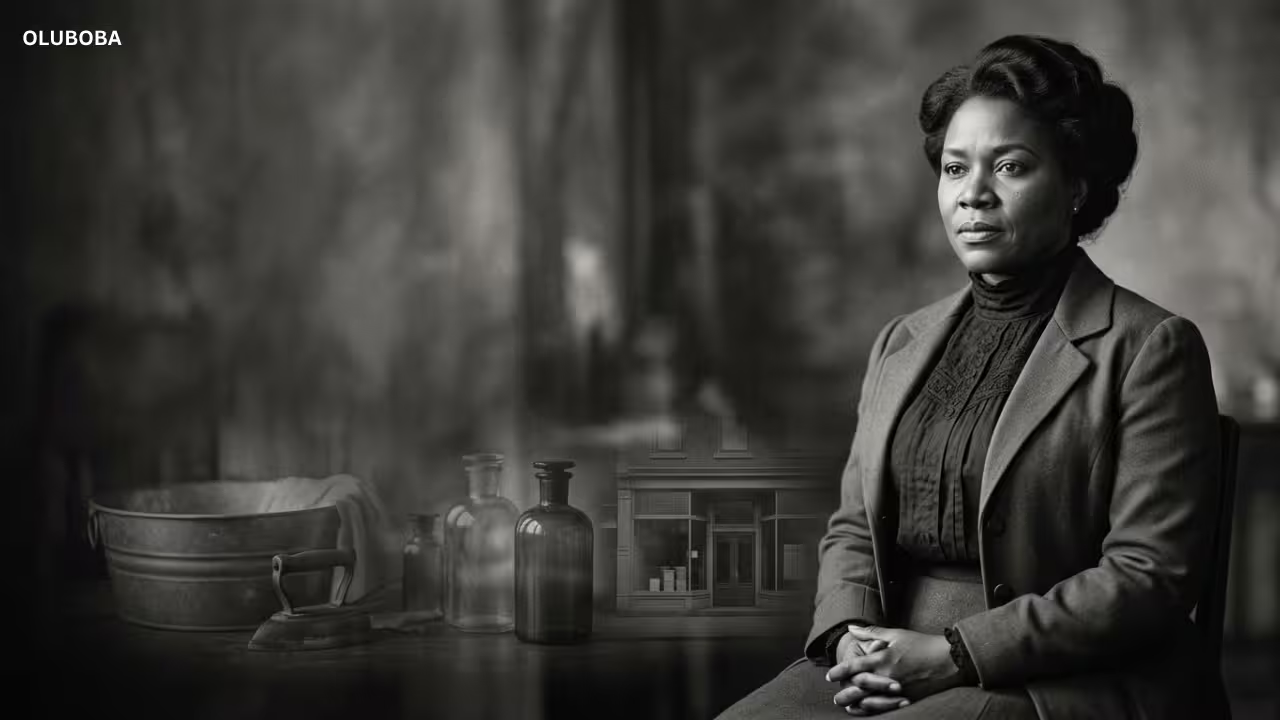
Sarah Breedlove was born on December 23, 1867, in Delta, Louisiana, as the daughter of Owen and Minerva Breedlove, previously enslaved parents who were working on a cotton plantation.
Sarah was the first in her family to be born in the period of post-emancipation in the United States.
Freedom, nevertheless, did not guarantee an easy way of life.
By the age of seven, Sarah had lost her parents. At the age of around 14, she married Moses McWilliams. She gave birth to their daughter, Lelia. Her husband passed away shortly after giving birth, leaving her to raise her daughter alone at such a young age.
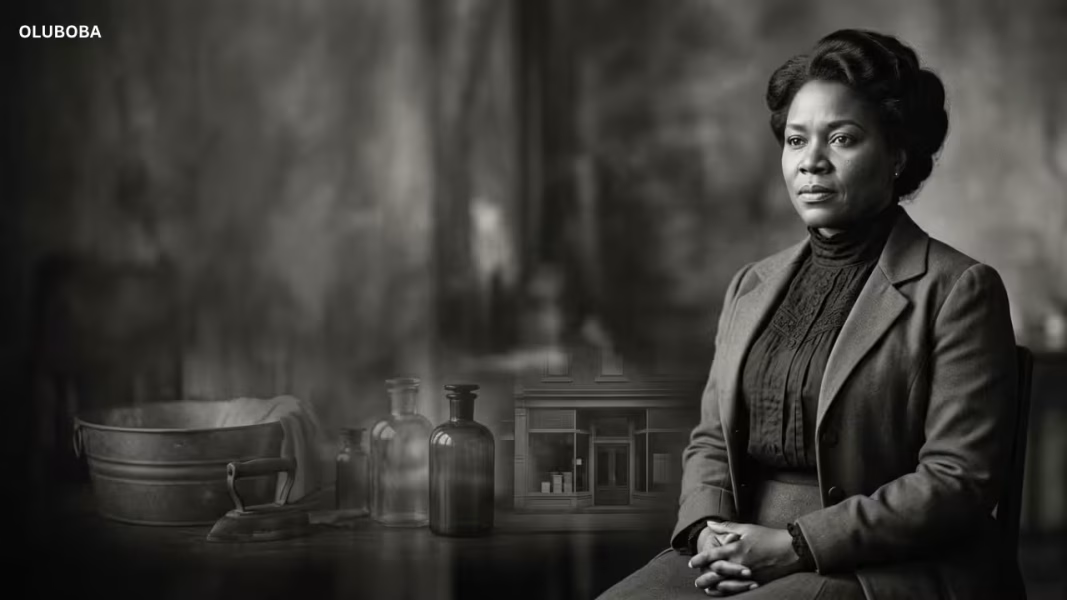
Sarah moved to St. Louis, where her brothers worked as barbers. For almost 20 years, she supported herself and her daughter through hard work in various low-paid jobs, including washing laundry.
She was familiar with poverty.
She was also well-aware of the economic limitations of being a Black woman.
A Problem Became an Opportunity
During the 1890s, Sarah suffered from severe hair loss. Women suffering from hair and scalp-related problems were quite common during that time, mainly because a lack of indoor plumbing and clean water was common among Black women during that time.
Moreover, products used by them could prove harmful to their hair and scalp. Sarah started searching for solutions.
Eventually, her quest led her to the growing black hair care industry. In the future, Annie Turnbo Malone, a black businesswoman who had developed a successful business by selling hair care products to black women, employed her.
It provided Sarah with one thing that she did not have before: practical knowledge about sales and entrepreneurship.
She learned how to show off products, communicate with clients, and build a network of women who could also sell beauty products.
However, she wanted to start something on her own.
In 1905, she moved to Denver along with her daughter. She had very little money; however; she started to produce and sell her own hair care products. She demonstrated products to people and taught women how to take care of their hair.
She was no longer searching for survival.
She was starting a business.
Why Did She Become Madam C. J. Walker?
In 1906, she married Charles Joseph Walker, who was a newspaper advertising salesman. Walker changed her name to Madam C. J. Walker, the name that would later make her famous throughout the entire country.
The name had become a brand.
However, Walker realized that only a good brand was not enough to establish a big company. She needed distribution, salesmen and some kind of organization which could work with customers from all over the country.
And she created it.
Walker traveled a lot, demonstrating her products and enlisting women who would sell them. She taught her salespeople about hair care, sales techniques, and how to dress well. Walker Agents were selling her products across the United States and even across the Caribbean.
Walker also founded schools where women were trained to work in the beauty business.
It is amazing, but her method was really practical: teach women some skill, give them something to sell, and organize a system where they will earn their money.
This method helped Walker to make her successful experience spread beyond herself.
What Was She Really Selling?
At first look, Walker was selling hair-care products. But that was just one aspect of her business. She was also selling possibilities.
In a period when Black women experienced high levels of discrimination in the workplace, Walker’s company offered them another avenue of earning their livelihood. Women were employed as sales representatives and as hair-care experts for her expanding company.
This meant that her company was not just a producer of cosmetic products. It was an economic system.
Walker knew one thing which is still important in business: a company grows quickly when it provides opportunities to those who can help it grow.
Rather than reaching out to everyone personally, she taught women to reach out to customers on her behalf .
She did not limit the opportunities to herself but multiplied them.
The woman who used to do laundry work was now providing work for others.
How Did Madam Walker Build Her Wealth?
Walker extended her business through a number of means.
First, she sold goods through direct marketing, employed agents, and also through mail order.
Second, she put her money into manufacturing and started operations to manufacture a variety of goods.
Walker’s business was expanding along with her fame.
Eventually, Walker became one of the most famous Black businesswomen in America. With her riches, she could enter a world which before was inaccessible to her because of her color.
But she did not just join this world and leave her background behind her.
Instead, she took advantage of her status to aid some causes she thought would benefit Black people.
That was another page in her biography.
What Did She Do With Her Money?
Walker was a prominent philanthropist.
She gave money to educational organizations, helped organizations that helped the black population, and made donations to campaigns against racial discrimination. Walker contributed to the YMCA and to organizations that fought against lynching and racism.
Moreover, Walker’s philanthropy was also connected with her belief in the importance of education and economic independence.
She encouraged women who worked for her to participate in public life and make their own contributions to charitable organizations.
Thus, for Walker, wealth did not mean only personal security. It was a means to an end.
Money could be used to educate someone. To provide him/her with opportunities. To support institutions and defend a community from injustice.
This outlook made Walker’s success more important than the mere prosperity of her business.
What Made Her Story Extraordinary?
It would be very easy to write about Walker’s life as a story of successful progression from poverty to affluence.
This would mean missing the most important aspect.
Walker began as an orphaned girl, then as a young widow, earning her living by washing.
Neither luck nor fortune made her a success. She learned. She sold to and listened to her clients. And she discovered how to create a system behind the product.
Above all, she understood that the opportunity for growth for her business lies in creating opportunities for others.
To me, this makes her story timeless, even now, more than a hundred years later.
Entrepreneurship is often defined as being able to see an opportunity and profit from it.
Walker showed yet another side of entrepreneurship: the ability to take an opportunity and turn it into a multiple one.
How Did Her Story End?
Madam C. J. Walker passed away on May 25, 1919, at her estate in Irvington, New York. She was 51.
She didn’t have time to witness the legacy of the company that she had created.
However, there was much more that Madam C. J. Walker left behind besides products.
There was a business structure, professionals, philanthropic organizations, and a concept of black female entrepreneurship that would inspire generations after her.
Her daughter, Lelia, later called A’Lelia Walker, would become one of the key figures of the Harlem Renaissance and would carry out some of her mother’s legacy.
Madam C. J. Walker’s own life spanned only 51 years, but these years were filled with several lives. She was an orphan, child labourer, wife, widow, mother, washerwoman, saleswoman, entrepreneur, employer, philanthropist and activist.
It is the distance between all these identities that made her story truly exceptional.
What Does Madam Walker’s Life Tell Us?
Madam C. J. Walker never had a choice about the environment into which she was born.
She could not dictate becoming an orphan. She could not dictate her being widowed from her first husband. And she could not dictate the racial discrimination which limited her options.
But she could choose what to make of the options which presented themselves to her.
She saw a problem in her own life and solved it. She developed a product out of her solution, a business out of her product, a network out of her business, and an opportunity for many other women out of her network.
This seems to be the most lasting aspect of her legacy.
Your starting point might have a big impact on your life, but that does not mean that it has to limit what you make of yourself.
Sarah Breedlove started out by washing clothes for others.
She died having made a place where others could earn a living and see a future.
And sometimes, that is all success amounts to: escaping your situation but making a way for another person to do so as well.