
The official campaign for the presidency of Nigeria in 2027 starts today.
Over the next year leading up to the presidential elections, politicians will promise Nigerians employment opportunities, safety, infrastructure, economic growth, an end to corruption, lower food prices, and a better future. Politicians will crisscross Nigeria, launch manifestos, and form, break, and possibly rebuild alliances.
But beyond all that politics, one has to wonder what will really influence how the citizens will vote?
The truth could be less about what the politicians will promise, and more about whether they think their lives are getting better.
That is the central political question that President Bola Tinubu will need to answer during his campaign for re-election. His government can talk about economic reforms that are being implemented and improved macroeconomic performance, while his opponents can talk about the suffering that Nigerians are enduring because of these reforms.
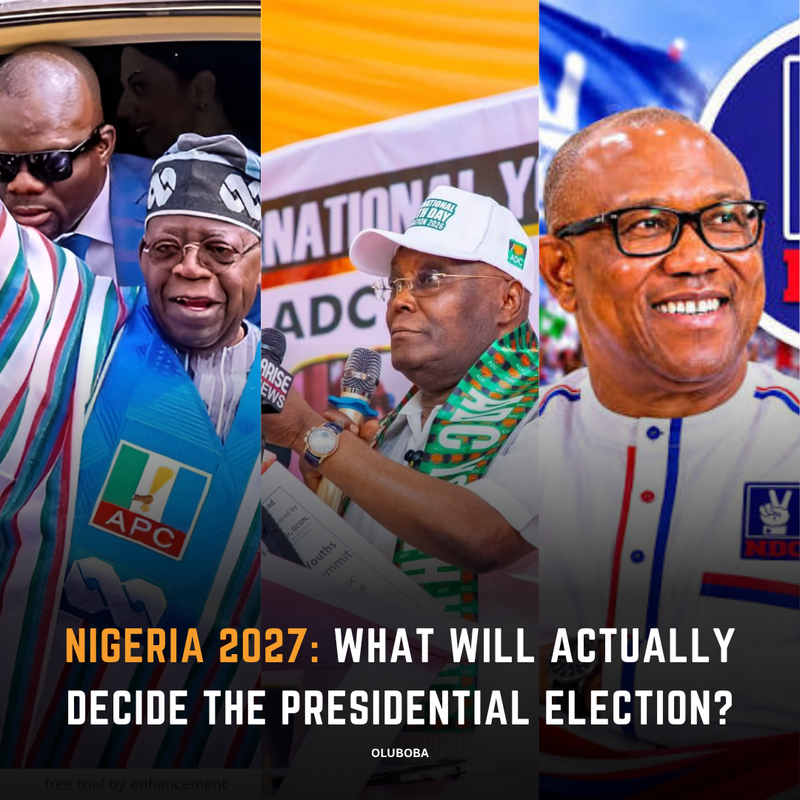
Somehow, somewhere in between the two narratives is the Nigerian citizen.
That makes 2027 a far more complicated race than a usual one pitting an incumbent against the opposition.
Tinubu’s Biggest Challenge Might Well Be the Difference Between Reform and Relief
Tinubu entered an economy that faced structural challenges. In response, his administration has pursued some of the most sweeping economic reforms that have happened in Nigeria in quite some time, such as scrapping the fuel subsidy and overhauling the foreign exchange regime.
These measures have been justified as a correction of an economy that was heavily skewed by decades of intervention. The reforms received praise from international organizations and foreign investors.
But economic reforms do not mean prosperity at home.
The reforms also created considerable hardship, including soaring transport, food, and operational costs. The difference between the two might prove very important in 2027.
The government’s reasoning could stem from strong revenue generation, economic development, an improved foreign exchange environment, or macroeconomic stability. Regarding the cost of food, the family will have an argument. The businessman will counter in terms of the cost of doing business. Young men searching for employment will counter in terms of unemployment.
Both parties do not necessarily talk about a totally different Nigeria. They both refer to different aspects of the same Nigeria.
And elections are usually won by the party that fully understands which aspects the voters value most.
The Economic Numbers Might Not End the Political Debate
That is where Tinubu’s defense deserves consideration.
The economy of Nigeria has been growing, and there have been positive developments on the economic front. According to a projection by the World Bank, the economy will continue growing despite inflationary pressures. It has observed improvements in Nigeria’s debt situation.
However, the government does have a valid point here as well. Tough reforms are never easy, and it takes time to reverse economic challenges that took decades to build up.
However, there is one more issue here.
A decrease in the rate of inflation doesn’t always mean that food has gotten cheaper. Economic growth doesn’t mean that any graduate has a job. An increase in the value of the naira doesn’t solve a family’s financial problems straight away.
That is one of the most important political questions of 2027: Will it be possible for Nigerians to see the results of better economic fundamentals before voting in the elections?
If yes, Tinubu’s arguments will have a significantly higher impact. If not, the opposition will use people’s memories of hard times as a political tool.
The elections may not be a straightforward vote on the economic necessity of reforms but on their cost-effectiveness.
The APC Is Also Defending More Than Tinubu
However, there is yet another issue the ruling party faces.
The APC has been in office since 2015. In the event of the 2027 elections, the APC will have been ruling Nigeria for close to twelve years.
This means that the 2027 elections will not be only about the suitability of Tinubu’s re-election. The people will evaluate APC’s performance over over ten years in office.
On the one hand, Tinubu can claim that he found a country with severe economic distortions and that some of the tough measures in his administration aimed at rectifying problems that have built up over the years.
The opposition can say that with the APC in power for more than a decade, it cannot keep blaming Nigerians for the mess that it inherited.
The key issue here is the extent of patience voters are prepared to show to the government in light of the benefits of reform that have yet to trickle down to their family budgets.
This is where political economy touches individuals.
The government will say, “We are rebuilding the foundations.”
The voter will say, “But can I afford the house?”
It is the tension between reform and reality which may be a key theme in the election.
The Opposition Has an Opportunity. But Opportunity Is Not Victory.
The opposition comes into the race armed with one thing that any underdog needs: discontent with the current administration.
However, discontent alone does not translate into victory at the polls.
The opposition is still divided, with individuals like Peter Obi and Atiku Abubakar attempting to forge their own political legacies amidst efforts to unite the opposition. Recent media reports have indicated problems in attempts to unite the opposition before 2027.
What emerges then is a unique political scenario: where Tinubu can win despite widespread dissatisfaction with his rule because Nigerians who oppose him do not have the capacity to unite around an alternative.
And it isn’t theoretical. This has happened before in 2023.
Tinubu garnered around 36.6% of the votes cast, followed by Abubakar at 29.1% and Obi at 25.4%. Rabiu Kwankwaso garnered around 6.2%.
The lesson is unpalatable but crucial: being an incumbent does not always entail enjoying mass appeal in order to succeed.
The opposition must also build a bloc that can turn dissent into majority votes. This makes how each one lines up against the other almost as crucial as their respective campaign pledges.
The Opposition Must Answer the Question After “Tinubu Has Failed”
That could well be its toughest test yet.
It’s one thing to run a campaign against an incumbent government. It’s quite another to then face up to the question: “What difference will you make?”
If the opposition claims that the economy under Tinubu has brought about unacceptably tough times, it must show how it can overcome the structural challenges without undoing the much-needed reforms.
If it pledges a reduced cost of living, it must show how. It needs to demonstrate the source of job creation if it makes such a pledge. If it pledges security, it must show why it can succeed where others failed.
Even when several opposition politicians make similar pledges, the people must determine who they believe will fulfill their pledges.
This is because the 2027 elections may not just be about the government versus the people’s dissatisfaction with the government, but about the various narratives about the challenges faced in Nigeria.
The APC narrative is that Nigeria requires tough structural reforms. The opposition will say that these reforms were excessively painful or improperly implemented.
However, at some point, everyone must ask the same question: How would a better Nigeria look from the perspective of a particular voter?
Nigerians May Not Vote According to Political Categories
Political campaigns operate on the premise that voters follow simple classifications. But they don’t.
One voter can be in favour of economic reforms and yet unhappy with the cost of living. A voter can be unhappy with the ruling government and yet suspicious of the opposition. One individual can be impressed with the policies of a particular candidate but support another for reasons of identity, geographical proximity, loyalty, or personal rapport.
And one voter can even change his mind midway through the electoral process.
That explains why sweeping statements on “what Nigerians want” need to be handled with care. There is no single Nigerian voter; rather, there are multiple voters who have varying backgrounds and concerns.
But some questions will remain universal regardless of such factors: Can I afford basic needs? Can I access employment? Can I afford the rent? Do I feel that the government appreciates my situation? Can I travel in safety? Can my children go to school?
These are the kinds of questions that can weigh more with an average voter than anything else in party manifestos.
Political parties ignore that at their peril.
The Election May Become a Battle Between Performance and Perception
This might turn out to be the most fascinating aspect of 2027.
A government may enhance the economic fundamentals yet still lose the election; an opposition party may capitalize on frustration among people yet lose.
Why?
Because elections do not deal with economic fundamentals but with judgments.
The Tinubu government will hope that Nigerians will judge it according to its future direction, while the opposition will hope that Nigerians will judge it by its past record.
These are completely different yardsticks for judging performance.
The government will say: “See the direction of development.”
The opposition will say: “See the price paid.”
And the voters will choose which is more important.
Thus, this will become a contest not just of policies but also of the perception of reality.
If the Nigerian people begin to sense that the economic situation is actually improving, the case for the government will be stronger; if economic parameters improve and people are still feeling under pressure, the case of the opposition will be stronger.
The political ramifications of the economy will thus be contingent not just on the figures, but on the time at which the people start to feel them.
The 2027 Election Is Not Yet Decided
This may appear obvious, but it needs to be stated.
The campaign is only getting started. Alliances in politics can shift. Campaign strategies for the candidates can shift. The opposition can become more or less united. Economic circumstances can improve or worsen. Security threats can arise. Unforeseen events could shape public opinion.
The Nigeria that will vote in January 2027 will not be the Nigeria that enters the campaign now.
And yet, this is exactly why predictions at this early stage need to be taken carefully.
What we can do now is to examine the framework of the race.
Tinubu has incumbency, ruling party organisation and economic reform experience to protect, while the opposition has public dissatisfaction to exploit, but still needs to overcome the problems of fragmentation and credibility.
But in the end, the voters have the ultimate advantage. They can hear all the promises, the attacks and the explanations before determining which Nigeria they prefer to believe in.
So, What Are Nigerians Actually Voting For?
We will also hear about Nigerians who are voting for development, good governance, security, competence, economic transformation, and the creation of a new Nigeria.
These could be relevant.
However, beyond all that is a far more intimate consideration:
Is my life going to improve with the continuation of this government or with a change of government?
This question cannot be answered in terms of GDP alone. This question cannot be answered on the basis of electioneering rhetoric, social media campaigns, and political rallies.
We can only answer it by weighing Nigerians’ experiences of the last few years against the future they have in mind for themselves.
This is why the 2027 election is not simply about Bola Tinubu and his competitors. It is a battle of interpretation over Nigeria’s present and future.
APC believes that Nigerians should see an uphill struggle that is gradually yielding positive results, while the opposition believes that Nigerians should see a government that has not done much to give any relief to its people.
It is for the voters to decide which one sounds more realistic.
This might just be the real contest of 2027.
Politicians will spend the next five months telling Nigerians how they should see things. It will be interesting to see if Nigerians buy their story.