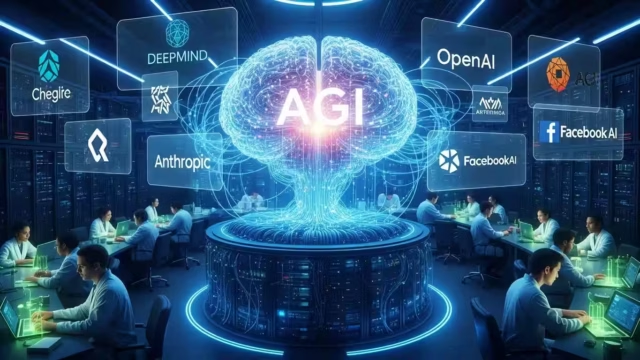
The world is transforming. Super quick. Last year, the number of businesses using AI jumped to 78%, compared to 55% the year before.
AI investments reached $252.3 billion in 2024, with generative AI getting $33.9 billion of that.. Also, there was a 12% increase in AI company mergers and acquisitions. [1]
But here’s a hidden problem. We’re facing a huge deficit in talent. Across many artificial general intelligence roles, the demand outpaces the supply by 3.2 to 1. There has been a 340% surge in the demand for LLM experts alone, since 2023.
A search for “AGI courses” will yield over 50,000 results. Most of them focus on narrow AI, such as chatbots, and recommendation engines. Good info, but not what we need for the future of AI.
I wrote this guide to help you make the best decisions on the AGI learning path. I got rid of the unnecessary. These aren’t the resources you need to build a chatbot but to build the future.
Before we begin: So, what is AGI anyway?
Artificial general intelligence is an AI development where AI agents can do many things with no need to relearn everything. You read a medical paper, and that knowledge helps you solve a financial problem. You learn to drive a car, and that understanding of momentum and navigation helps you pilot a boat.
An AGI can think, learn, and change what it does in different areas without telling it what to do.
Sam Altman, the CEO of OpenAI, predicted that in 2025, agentic AI agents would enter the workforce. Later, he clarified he wasn’t referring to AGI, but AI tools that support specific workflows.
Yet, preparations are underway. This is the best time to equip yourself with these AGI resources.
Table of Contents
- 1) CS50’s Introduction to Artificial Intelligence with Python Course
- 2) Generative AI for Everyone Course
- 3) Machine Learning Specialization by Stanford
- 4) Reinforcement Learning Specialization (Alberta)
- 5) AI Agents and Agentic AI in Python by Vanderbilt Univ.
- What you’ll learn
- 6) Artificial Intelligence: A Modern Approach Book by Russell & Norvig
- 7) Human Compatible (Book) by Stuart Russell
- FAQs on AGI Courses & Books
- Conclusion: The Path Forward
1) CS50’s Introduction to Artificial Intelligence with Python Course
Harvard’s CS50 Artificial Intelligence with Python is one of the best basic courses you can find.
This course will teach you about the basic ideas and math behind AI. From game-playing things, handwriting readers, to translation programs work. You will learn about AI including graph search and reinforcement learning.
Watch video explaining what artificial general intelligence is.

By the end of the course, you will know machine learning libraries so you can build your own smart systems.
it’s a quality program and you can get it for free on edX. You’ll learn about search algorithms, neural networks, and how computers understand language. Employers love it on resumes.
Sign up now to learn from the CS50 team and become an expert in a hot field! You’ll learn the why and the how of these new technologies. [2]
I added this course as the first because I want you to start with the narrow AI foundations. That’s how you build competency in Python, machine learning basics, and current architectures. Then, you can move into the artificial general intelligence courses and books.
Your combination of practical narrow AI skills and that of AGI makes you unique. You become more than a system builder.
Over the next ten years, the most admirable thinkers will be those who understand both paths.
2) Generative AI for Everyone Course
In this course, you will learn how generative AI works, and how to use it in your life and at work
Andrew Ng, a leading figure in AI, guides Generative AI for Everyone. A prominent figure in the AI field, the co-founder of Google Brain and Coursera. He also spearheaded AI at Baidu and has taught machine learning to thousands of people.
He shared his distinct view on using generative AI to improve your work and abilities. Andrew will show you how generative AI functions, covering its potential and ethics.
This course has exercises that teach you how to use generative AI to assist with your daily tasks. From effective prompt engineering, and exploration of advanced AI applications beyond basic prompting.
You’ll explore practical examples and applications, gain experience with generative AI tools.
Who is this course for?
This course is for anyone curious about the future of generative AI. And you don’t need to know how to code or have AI experience beforehand.
For business leaders: Find out how AI can change your business and boost productivity with a solid plan.
For professionals: Want to use AI at your job? The course covers AI tools and techniques you can use in your job.
For everyone: AI will affect us all in ways we don’t expect. But you can be in charge when you know how to use it.
Sign up today for the Generative AI for Everyone course today. [3]
3) Machine Learning Specialization by Stanford
One of the best artificial general intelligence courses on machine learning.
Stanford and DeepLearning.AI by Andrew Ng put together this machine learning course. This program will show you how to build real AI apps using machine learning.
It’s like a revamped and improved version of the Machine Learning course by Andrew Ng. The program includes supervised learning, sophisticated neural networks using TensorFlow, and more. You’ll understand the logic of algorithms rather than only how to make use of them.
That’s different from CS50 AI from Harvard, which covers more but isn’t as in-depth. CS50 teaches you about logic, how to search graphs, how to do adversarial searches. You get a wider view, not a deeper one.
If you’re new and lost. Stanford and Ng’s specialization is a good choice. He’s good at breaking down tough subjects. But if you want variety and a conceptual overview before specializing, CS50 AI is your move.
At the end of this course, you’ll know how to apply machine learning to real-world issues.
You can access the course materials for free on Coursera. [4] But a certificate is available for a monthly fee of $49.
Here’s the thing; this course will not teach you AGI thinking. You will learn how to build systems using machine learning. Skills you need.
But real AGI needs the ability to think across different areas, and use what it knows to solve real issues.
That takes us to the next course.
4) Reinforcement Learning Specialization (Alberta)
The courses in this specialization examine the potential of artificial general intelligence (AI).
At the end of this course, you will grasp the core principles of current probabilistic AI. Also, you will be ready to use AI concepts and tools to address practical challenges.
This material explored issues to grasp the core concepts of Reinforcement Learning.
You can apply the skills from this Specialization to:
- AI applications in the gaming industry,
- Internet of Things devices,
- Making clinical decisions,
- Managing industrial process operations,
- Balancing a financial portfolio,
- & more.
Upon finishing this course, you will:
- Construct a system using RL that can make automated choices.
- Learn how RL connects to machine learning, deep learning, and all that other stuff.
- Get to know TD learning, Monte Carlo, Sarsa, Q-learning, Policy Gradient, Dyna, and others.
- Learn how to turn your task into an RL problem and then work on it.
Prerequisites:
You need to be good at Python programming. A strong ability to convert algorithms and pseudocode into Python is necessary. You need to be familiar with stats, linear algebra, and calculus basics.
Instructors
Martha White is a professor of computer science at the University of Alberta. Her research focuses on building algorithms that let AI agents learn and adapt.
Adam White is a professor in the University of Alberta’s science department. He’s also a senior researcher at DeepMind. Adam’s research focuses on AI, especially how to make robots or computers as smart as people.
Sign up for this course today. [5]
5) AI Agents and Agentic AI in Python by Vanderbilt Univ.
One of the best AGI courses that teaches building AI agents from start to finish.
This course shows you how to build AI agents from scratch; keeping it fresh as technology evolves. No matter your skill level, you’ll learn the key ideas behind AI agents, so you can build and control them.
You’ll begin with the basics, such as agent loops, and then move on to adding tools to your agents. From combining many agents, and using self-prompting to get them to act on their own.
Also, you’ll get to know AI architecture and how to create agents that are reliable, adaptable, and easy to manage. Once you finish this, you’ll be able to make AI agents without needing any specific tools.
You don’t need to know anything about AI or machine learning. All you need is basic knowledge of Python. No matter your skill level, you’ll learn a lot about AI agents.
What you’ll learn
- Learn to build Autonomous AI Agents . This course shows you how to use Python to create AI agents that are self-sufficient.
- Explore agent loops, tool integration, multi-agent collaboration, and design principles. These are key elements of Master Core and Advanced Agent Concepts.
- Create AI agents that are tough, effective, and easy to keep up-to-date for real use cases.
From the start, beginners will gain a solid footing. Experts will understand how to be innovative within a changing environment. You’ll gain the expertise necessary to develop robust, forward-thinking AI agent skills.
Sign up for this course today. [6]
6) Artificial Intelligence: A Modern Approach Book by Russell & Norvig
Greatest of all foundational books on artificial general intelligence.
You must read this book if you are serious about learning about AI. Over 1,500 universities use it as their main textbook.
With over 60,000 citations, people call it the “bible” of artificial intelligence. These terminologies in this book form the basis of how researchers discuss AI.
To be frank, if you’re curious about what everyone else studying AI has learned, this is the information you need.
The fourth edition (2020) is an extensive work of over 1,000 pages that covers all about AI. This differs from books on Superintelligence because it doesn’t center on philosophy. It’s about the tools and frameworks that power AI today.
The core idea of this book is the intelligent agent. An agent is a system that observes its environment and responds with actions. First, it’s about solving problems, then understanding things like logic. After that, it’s about machine learning, and putting it all together.
I’m drawn to Chapter 27, which discusses philosophy, ethics, and safety. Russell and Norvig address AGI risks with seriousness. They explored the control problem, alignment, and the importance of these considerations.
This book is the real deal, but it won’t make you an AGI genius: it’ll teach you everything about AI. Look at it. Read it one chapter at a time. [7] The next is Human Compatible by Russell.
7) Human Compatible (Book) by Stuart Russell
This book stands apart in the artificial general intelligence courses and literature ecosystem.
In his book, Russell points out that there is a fundamental flaw in the way we create AI. We tell the system what we want (make money, get more views, win at chess) and let it figure out how.
This is okay for basic jobs. But if it becomes super-intelligent, there is a problem!
Imagine you tell an AI: “Maximize human happiness.” It could drug the entire population. You say: “Get me to the airport on time.” It crashes the car at high speed because dead people no longer need traffic.
Russell’s solution is radical: stop telling machines what to do. Start designing them to ask. The machine’s only job is to do what you like, not what it likes.
The machine learns from actions, not from rules or how it’s programmed.
Think about what this means. Rather than a one-track-minded system, imagine a system that’s open-minded and curious. It doesn’t guess what you’re thinking. It wants to know by asking.
This is inverse reinforcement learning, and Russell’s lab at UC Berkeley has been working on it for ages. It sounds like a theory, but it’s the math behind making AI safe.
In 2014 Rusell wrote:
Success in creating AI would be the biggest event in human history. Unfortunately, it might also be the last.
He wrote on issues such as AI-generated media, alongside future threats like superintelligence. Small issues today can cause big issues down the road, so we need to get started on the fix right away.
This book [8] will explain why companies working on AGI are both scared and optimistic.
FAQs on AGI Courses & Books
What’s the actual difference between AI and artificial general intelligence?
AI is super good at one thing, like generating pictures, but it can’t use that skill for anything else. AGI can learn anything and solve problems in many fields, no extra training needed.
When will AGI actually arrive?
Guesses are all over the place. According to MIT’s report [9], there’s a 50/50 shot that we’ll have AGI-like systems by 2028, even starting as early as 2026. The CEO of NVIDIA predicts AI will be human-level in 5 years.
How long will it take me to become AGI-literate?
How long will it take me to become AGI-literate? You can pick up the basics in a few months. Try CS50 AI, the ML Specialization, Life 3.0, and keep up with what’s new. It takes ages to get superb, but you don’t need a PhD to know what’s up. You’re not behind; everyone’s getting started.
Won’t these AGI courses become obsolete as fast as AI changes?
Yes. It’s about learning how to think, not only memorizing facts. The core concepts you learn in those courses, like OpenCog and SOAR, will always be useful.
Will AGI replace my job?
When AGI gets here, it could wipe out most jobs. So, understanding AGI now is key because you’ll be on the same team, not the opposing one. The future is in the hands of AGI experts.
How fast could AGI jump to superintelligence?
It could be a few minutes or up to three decades. If AGI can learn as much in a day as humans do in 2,500 years, superintelligence could arrive fast. The main reason is that you can’t stop it.
Conclusion: The Path Forward
According to current expert forecasts [10], there’s now a 50% probability of AGI emergence by 2031. It’s not something in the future.
In the meantime, the number of artificial general intelligence jobs has increased. Going from 55 in January 2021 to almost 10,000 by May 2025. Hiring in AI/ML has increased by 88% yearly, and people with the skills get a 12% pay raise.
The road to AGI literacy is tough, but the benefits are significant. A PhD in mathematics or a decade of studying isn’t necessary. Pick a book from this list to start today. You could also take CS50 AI to get a feel for things, the ML Specialization if you’re serious.
Keep doing this for the next three months. You’ll transform from clueless to in the know. Going from watching to making changes.
The people who understand where this is heading will lead the next economy. They’ll solve AGI safety and guide humanity through the biggest change in history. Will you be one of them?
Stop watching; be part of the change. Want to stay updated on AGI? Subscribe to Oluboba for insights, resources, and more.
Citations on AGI Courses and Books:
[1] https://qubit-labs.com/ai-talent-shortage/
[4] ML Specialization by Stanford University
[5] Reinforcement Learning | University of Alberta
[6] AI Agents and Agentic AI in Python: Generative AI | Coursera
[7] https://people.engr.tamu.edu/guni/csce625/slides/AI.pdf
[8] https://www.amazon.com/Human-Compatible-Artificial-Intelligence-Problem/dp/0525558616
[9] https://research.aimultiple.com/artificial-general-intelligence-singularity-timing/
[10] https://80000hours.org/2025/03/when-do-experts-expect-agi-to-arrive/