
Imagine that you receive news about a company you know going to issue its shares to the general public.
For many years, perhaps, the business might have belonged to its founders and some other private shareholders. But now you could have an opportunity to become the shareholder yourself. However, the process of purchasing the stake could make you ask such questions as what an IPO is and how IPO works.
And this is where the matter becomes rather complicated.

An IPO, or an initial public offering, means that the privately owned company goes public and issues its shares to the general public. In that way, the company can gather necessary funding for development, whereas investors will have an opportunity to become the shareholders of the company.
However, becoming a shareholder of the company issuing IPO shares is not as easy as seeing the offer and purchasing the shares. IPO involves certain process, pricing, regulations, and risks.
Therefore, let us start from scratch and find out how IPO works, why companies decide to go public, and how IPO shares can be purchased.
What Is An IPO?
IPO means the Initial Public Offering. This term refers to the procedure when a firm for the first time starts selling its stocks publicly.
One may say that a firm is like a cake. Before the IPO, only a few people can possess this cake: its founders, early investors, and others. In the case of an IPO, the firm divides the cake into stocks and sells some of the shares to the public.
After purchasing stocks, one will be the owner of a certain part of the business.
Another benefit of the IPO procedure is the possibility of raising capital. The firm can use this capital for development, production, expansion of markets, payment of debts, or anything else.
It is necessary to mention one more important thing. The IPO is different from the buying of shares at the stock exchange. IPO is the procedure of selling stocks to the public for the first time. After listing, these stocks become tradable at the stock exchange.
Therefore, when a company says it will be going public, it means the company will shift from being privately held to becoming publicly held via a process that could involve an IPO.
Now that we know what an IPO entails, let us take a detailed look at the process involved in making an IPO work.
How Does an IPO Work?
It is worth noting that the process of going public takes time. There are several things that the company needs to do before making its shares available to the public via the process of an IPO.
Below is the process involved in making an IPO work.
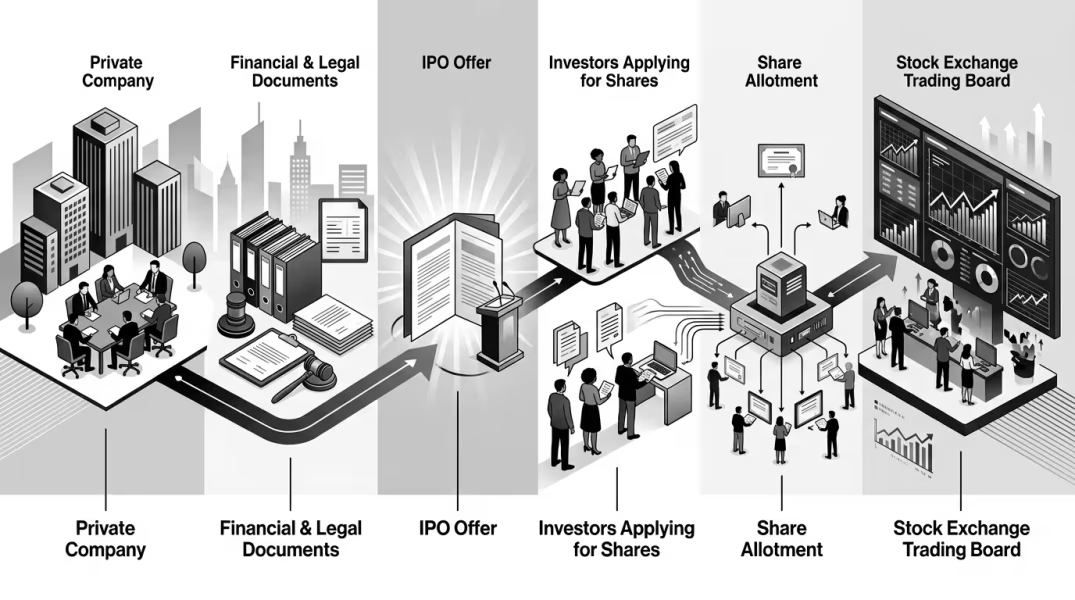
1. The company decides to go public
There might come a time when the company requires additional capital to expand its business operations. This could include expansion of its operations, the production of new products or services, entry into new markets or even reduction of debt burden.
The alternative route that the firm can consider instead of private sources of capital is to opt for selling some shares to the public.
The journey to IPO begins here.
2. The company chooses its advisers
The firm hires a group of professional individuals who will advise the company on how to proceed.
The advisers include the investment bankers, underwriters, lawyers and accountants among other experts.
3. The company prepares its documents
Prior to the investments by the potential investors, there has to be sufficient information available.
A document referred to as a prospectus is compiled by the company in which information is provided about the firm, its financial position, management team, the use of capital raised and risk factors.
4. The IPO price is set
The company and their advisors determine the number of shares to be sold and the price per share.
That is the point when the fun begins. The company needs to raise enough money from the sale of the shares, but also at a price acceptable to the investors.
5. Applications for the shares are submitted by investors
Applications for shares open and eligible investors submit their applications through the designated route.
You make your application, stating how many shares you would like to purchase and according to the terms and conditions of the offer, you pay the stipulated amount.
But that does not necessarily guarantee that you will receive the shares you apply for.
6. Shares are allotted
When the number of applications for the share exceeds the number of shares available, the IPO is said to be oversubscribed.
Accordingly, allotment of shares will be done as per the terms stated for the allotment of shares.
7. The shares become available for trading
After the IPO process is completed and the allotment of shares is done, the company becomes listed on the stock exchange.
At this stage, the shares of the company become available for trading. After that, the share price will be able to fluctuate upwards or downwards depending on demand, company’s performance, and other factors.
Thus, the IPO process consists of several stages: the company decided to be listed, it made preparations to the offer, it sold its shares, and now the company is listed on the stock exchange.
Why do Companies Launch IPOs?
Not all companies launch IPOs because the process itself looks impressive. In the majority of cases, there is a commercial reason for launching IPOs.
It is connected with the main reason – money.
Get financing for expansion
A business could need funds to set up new branches, construct plants, hire staff, innovate products, or enter new markets.
An example is when an expanding business has a good business model but lacks sufficient funds to finance its next phase of expansion. An IPO would enable such a business to gain access to a larger pool of investors.
Provide a way for current investors to exit
The founders and early investors of a business might have been locked in the business for a number of years.
Going public could provide them with an opportunity to exit their business, depending on the IPO regulations.
Create a more prominent company
Being a public firm can also make a company more noticeable. In the event that a company requires capital in the future, it becomes easy for a company to be able to re-enter the public markets.
However, there is always a price to pay when one decides to go public. There are now many more obligations that a firm has to meet.
In conclusion, therefore, although an IPO offers a company a great tool to raise funds, it comes with some costs associated with being a private firm.
How Do Investors Make Money From an IPO?
When an investor buys shares during an IPO, he buys a part of the business. But how does the investor benefit from the deal?
Here are two possible scenarios:
Your shares appreciate in price
For instance, if an investor purchases 100 shares priced at ₦10 each, he spends ₦1,000.
However, after the company is listed on the stock exchange, other people might be ready to pay for each share up to ₦15. So, 100 shares would cost the investor ₦1,500.
The profit of the investor from the deal would be ₦500, without counting transaction costs and taxes.
On the other hand…
In case the market price goes down to ₦7, the investor’s total sum of 100 shares would be ₦700.
This way, the investor would lose ₦300 if he sells his shares.
So, IPO does not mean automatic profits for the investor.
You can receive dividends
The firm can also decide to share a portion of the profits with you by way of dividends.
If you own 100 shares and the firm decides to give ₦2 dividend per share, you get ₦200, depending on the dividend policy of the firm and taxation issues.
Not all firms pay dividends; some decide to retain their profits and use the funds to expand their business.
This is the reason why you have to be very careful not to judge the potential growth of the stock based on the price increase alone. You have to be able to know something about the business you are buying stocks in and determine whether you are happy to invest for the long term in the business.
How to Buy IPO Shares
After understanding what IPO means, the next question that pops up in your mind can be: How do I buy IPO shares?
Although the method differs from country to country and from one IPO to another, the concept remains the same. You just need to find out whether the firm is selling shares, find out about the offer, confirm whether you can apply, and apply.
1. Find an IPO
You must find out about an official offer to investors regarding the issue of the shares of an initial public offering. Do not rely solely on what you find posted or advertised online.
Find out who is making the offer, when it opens and closes, the price of the offer, the number of shares offered, and which investors qualify for application.
2. Go through the prospectus
Prior to putting your money in the IPO, go through the IPO prospectus.
This will tell you all about the company, its activities, how it generates income, the financial position of the company, what the company intends to do with the money raised, and the risks involved in investing in it.
You need not be an expert in finance in order to understand what is going on.
3. Apply for IPO
If you have made up your mind to invest, go through the process of applying as stipulated in the official offer documents.
Based on the particular IPO, you would need to apply through one of the approved stockbrokers, issuing houses, banks, registrars, or other approved channels.
4. Wait for your allotment
When the offer period ends, the shares will then be allotted to investors.
If the demand for the IPO is higher than the supply of shares, you will receive less than what you have applied for.
5. The shares begin trading
Upon the listing of the company, your allotted shares will then trade on the stock exchange.
At this time, the market price can rise or fall depending on the price at which the IPO was issued.
This is the reason why an IPO should not just be about timing the purchase. It is because you become a shareholder of a business.
How to Buy IPO Shares in Nigeria
For one in Nigeria, buying IPO stocks involves the same process, but the difference comes with how you should go about acquiring that specific public offer.
Rule number one is to ensure that the public offer is real before you commit your cash to it.
Here is a step-by-step guide on how to buy share in Nigeria.
1. Identify a legitimate public offer
To do that, use official information sources from the company issuing the IPO, the issuing house, the SEC, NGX, or the registrar dealing with the offer.
You must find out the offer price, start and end date of the offer, the number of shares being offered, minimum application, and eligibility for the offer.
Do not be fooled into thinking that a WhatsApp message, social media post, or advert forwarded through the web is sufficient.
2. Go through the documentation of the offer
Before submitting your application, read the prospectus or the official documentation on offer.
Take time to find out what the company is all about, its financial performance, intended use of the money being raised, management, and associated risks.
3. Submit through the approved channel
The way you submit your application will depend on the offer. This could involve submitting through an approved stock broker, issuing house, registrar, bank or any other authorized website.
Follow all the guidelines provided in the official documents of the offer. Remember not to make payments to a personal bank account or an unauthorized intermediary just because they say they are working for you as an investor.
4. Allotment process
After the offer period expires, applications will be processed and share allotment will take place according to the terms of the offer.
If the offer is oversubscribed, you may receive less number of shares than you applied for.
5. Shares after the listing process
Once the shares have been listed on the Nigerian Stock Exchange and are available for trading, the price of the shares could go above or below the IPO price.
This is the time when you will either hold the shares, get dividend in case the company decides to pay out dividend or even sell the shares through the normal stock market process.
What matters most is that you should not buy just because it is an IPO.
How Much Money Do You Need to Invest in an IPO?
You do not need millions of naira to buy into every IPO.
The amount depends on the offer price per share, minimum number of shares that I am willing to apply for and any charges involved.
Let’s say that the offer price is ₦20 for each share and the minimum application is 100 shares; therefore my minimum investment will be:
100 x ₦20 = ₦2,000
However, if I want 500 shares, then the amount will be:
500 x ₦20 = ₦10,000
Each offer will have a different minimum, so make sure you refer to the terms of the offer before buying the shares.
What happens when the IPO is oversubscribed?
This is where it gets more exciting.
If I apply for 1,000 shares but there are many more investors applying than the number of shares the company wants to offer, I might not get 1,000 shares.
I might get a lower number depending on the allotment process of the offer.
Therefore, I can’t expect that the total number of shares that I applied for will be bought.
Is it wise to put all your money in an IPO?
It is not.
It may be tempting to jump on an IPO when it is the topic of the day. However, bear in mind that the stock can go down after the listing.
Stick only to the amount that you are willing to lose and make sure that the investment is aligned with your financial needs and goals.
A key question is not necessarily how much you could invest in an IPO but how much you could afford to without compromising your finances.
What Is an IPO Prospectus?
When investing in an IPO, there is one important document that you should definitely look into.
The prospectus is essentially a detailed presentation of the company made by the issuer specifically for you, as a potential shareholder. In other words, it is the information you require for the decision-making process.
The prospectus can help you understand what the firm does, its financial performance, its plans for the raised funds, and potential risks associated with the investment.

What should you be interested in when examining an IPO prospectus?
It is unnecessary to interpret it as an expert would do. You should begin with information that can shed light on the investment process.
Here they are:
- The company itself: What product does the business provide and how does it generate income?
- Financials: Is the company profitable and its revenues are increasing?
- Management team: Who owns and operates the enterprise?
- Application of funds: How is the money raised going to be spent?
- Price of offering: How much is one share going to cost you?
- Risk factors: What can possibly harm the company or your investment?
- Terms of the offer: When is the opening/closing date and what are the offer terms?
Sometimes a prospectus is quite lengthy, however, you are not supposed to avoid its reading completely since if you are going to invest money into a certain company, you should have an idea about it.
Moreover, a prospectus cannot serve as a guarantee of successful investment returns.
Risks of Investing in an IPO
Investing in an IPO offers an opportunity to get some ownership of a company at the time it starts to become a publicly traded entity. However, this does not guarantee profits from such an investment.
On the contrary, the stock price might drop right after the listing. And that is why you need to think twice before getting involved in the hype surrounding the IPO.
The stock price might drop
You might buy stocks at the IPO price, just to witness their market price falling afterward.
This may occur due to lower investor interest, changes in market circumstances, or because the value of the company turned out to be lower than anticipated.
You might overpay
Even a great company might turn into a terrible investment choice if you pay too much for it.
It is recommended to examine the earnings, growth, debts, and offer prices of the company.
The business can face challenges
A business might have grandiose plans for an IPO, but fail to deliver on its promises.
Profits could go down. Expenses could increase. Competitors could emerge. The management could make poor decisions. Each of these would impact the value of your stake in the company.
You may not be able to get your money out at a favorable price
Even after the business goes public, you still require someone to buy your shares. If the market is thinly traded, selling off your holdings could prove difficult.
In essence, the basic idea is that an IPO is not an easy way out. When you invest in such a business, you are putting your money on the line in the same way as any other stock investment.
Do your homework before you put your money on the line.
IPO vs Direct listing vs SPAC
An IPO is one way for a business to list itself as a public firm. However, you might come across other methods like direct listings and SPACs.
They all involve a similar end result but follow different paths.
| Feature | IPO | Direct Listing | SPAC |
|---|---|---|---|
| What happens? | Company offers shares to public investors | Existing shares begin trading on an exchange | SPAC merges with a private company |
| Does the company raise new money? | Usually, yes | Not necessarily | Depends on the transaction |
| Who sells the shares? | Company and sometimes existing shareholders | Existing shareholders | SPAC investors and other shareholders |
| How does the company become public? | Through a public share offering | Shares are listed directly on an exchange | Private company merges with an existing public SPAC |
| Simple example | “We are selling new shares to the public.” | “Our existing shares can now trade publicly.” | “We will become public by merging with this SPAC.” |
| Main idea | Raise capital and become publicly traded | Start public trading without a traditional IPO | Use an existing public company to go public |
IPO
An IPO is a method in which a company raises funds from public investors through its stock issuance. It allows a company to raise additional funds while the existing shareholders can sell some of their shares.
The stocks can be listed and tradeable on an exchange.
Direct listing
Direct listing is when the existing shareholders can sell their shares in an exchange without going through the process of issuing new shares as in the case of an IPO.
Direct listing allows the shareholders to sell their stocks but may not always lead to additional funds being raised.
SPAC
A SPAC or a Special Purpose Acquisition Company is a firm that sets up its own IPO for the purpose of subsequently acquiring or merging with a privately held business.
Rather than doing its own IPO, the company can be taken public through a merger with SPAC.
What is the simplest way to differentiate between the three for a beginner?
IPO: The firm issues stock in an offering to the general public.
Direct listing: The firm’s shares are listed directly on the stock exchange by its existing shareholders.
SPAC: A public firm merges with a privately held firm.
Note that each route may come with distinct consequences.
What Happens After an IPO?
There is more than issuing the shares after the IPO stage is over.
The trading of shares can begin once they are listed on the stock exchange. The price will depend on the market conditions and what people are ready to pay for the shares of the company.
Share price can fluctuate
The IPO price is not the final price of the shares.
Once the shares are traded on the stock exchange, the price may change depending on various factors including the demand for the share, performance of the company, economic conditions, and others.
Depending on whether the buyers outnumber sellers or vice versa, the share price can go up or down.
The company becomes responsible to public shareholders
Public companies have more obligations than private ones regarding disclosure of information. Investors start to monitor the company’s performance closely.
It is also important for the company to continue fulfilling the requirements of the stock exchange and the regulator.
Investors can trade with their shares
After listing, investors can usually trade their shares using the usual procedures of the stock market.
You are not working with the application price anymore. You are working with the market price.
This is an important point.
An IPO application involves buying shares at the offer price. Post-listing trading involves buying shares from another investor at the market price.
Hence, participating in an IPO application is just the start. The next question is how well the company will be able to develop and increase its value as a publicly traded one.
Frequently Asked Questions about IPOs
What does IPO mean?
IPO is the abbreviation of Initial Public Offering. This is the procedure when a private company starts selling its shares to investors. It is a process that allows a privately held company to go public by issuing shares to investors.
How is an IPO process conducted?
The company makes a decision to issue its stocks, prepares all necessary paperwork, formulates the terms of the offer, solicits applications from potential investors, allocates the shares, and eventually the shares are listed on the stock exchange.
Does anyone have access to the IPO stocks?
No, not necessarily. Different IPOs have different regulations concerning who is eligible and how to submit an application for the shares. It is necessary to study the offer documentation thoroughly before making any applications.
Are IPOs risk-free investments?
Any investment carries a certain level of risk. The stock may depreciate once it is listed, as any other stock. It is important to know everything about the company, its financial situation, and offer price before investing.
May I sell IPO shares immediately?
Once the shares are listed and trading commences, it becomes possible for investors to sell their IPO stocks via the stock market.
What would happen if an IPO is oversubscribed?
In case of oversubscription, the shares are allotted depending on the rules provided in the offer document. You may get a smaller number of shares than applied for.
How is an IPO different from a stock?
An IPO refers to the process of offering the company’s shares for the first time in the public market. The stock refers to the shareholding of any company. Once an IPO is over, the shares start trading as stocks.
How do I find a genuine IPO?
You can find information about the IPO from the source related to the company or the regulator, stock exchange, issuing house, or registrar. Avoid believing in the IPO offer made through some anonymous social media accounts, WhatsApp messages, or some other unauthorized websites.
Does an IPO always earn money?
No. There is no certainty that an IPO will be profitable. In some cases, the IPO makes good returns, whereas the stock price of the IPO may go down after listing. The IPO will be profitable or not depends upon how the investment performs after purchasing the same.